Most maintenance guides treat every climate the same. That's a problem for Sanford homeowners, where relative humidity regularly pushes past 70% and standard filter replacement timelines fall short by weeks. We see it firsthand in the filters customers send back — saturated, warped, and failing months earlier than expected compared to identical filters in drier markets.
After manufacturing millions of air filters and analyzing real-world performance data across Central Florida, we've identified the specific failure patterns humidity triggers: accelerated filter media breakdown, condensate drain blockages, and coil fouling that drives energy costs up long before homeowners notice a problem.
This guide shares what we've learned directly from that experience — a component-by-component breakdown of humidity's impact on your system and a localized maintenance schedule designed for Sanford's climate, not a generic national average.
TL;DR Quick Answers
HVAC Maintenance in Sanford
HVAC systems in Sanford work harder and wear faster than in most U.S. markets. Year-round humidity averaging 70%+ saturates air filters 2–3 weeks ahead of schedule, accelerates coil fouling, and creates ideal conditions for mold growth inside ductwork and drain lines.
After manufacturing millions of air filters and tracking performance data from customers across Central Florida, we recommend a humidity-adjusted maintenance routine:
Air filters: Replace every 30–45 days in summer. Every 60 days the rest of the year.
Condensate drain line: Check monthly from May through October.
Evaporator coil cleaning: Professional service twice per year — spring and fall.
Duct inspection: Annually for leaks, moisture intrusion, and insulation gaps.
MERV rating: MERV 8–11 pleated filters for most Sanford homes. Higher ratings can restrict airflow in systems not designed for increased static pressure.
The most common failure pattern we see across Seminole County starts with a filter that stayed in too long. Saturated filter → restricted airflow → coil fouling → reduced dehumidification → service call. Interrupt the chain at the filter and most downstream problems never develop.
Sanford homeowners who follow a localized schedule instead of generic 90-day guidelines consistently report lower energy costs, fewer emergency repairs, and longer equipment life.
Top Takeaways
Sanford's humidity destroys HVAC components faster than national guidelines assume. Average humidity exceeds 70% year-round. Filters saturate 2–3 weeks early. Condensate drains clog more often. Generic 90-day maintenance cycles don't hold up here.
A filter that stays in too long is the #1 failure point in humid homes. Not compressors. Not refrigerant leaks. After tracking thousands of filter returns across Central Florida, premature saturation is where the majority of humidity-related problems begin.
A localized maintenance schedule protects your system and your wallet. Filters every 30–45 days in summer, 60 days the rest of the year. Condensate drain checks monthly during peak humidity. Professional coil cleaning in spring and fall. Duct inspection annually.
Duct leaks in Sanford aren't just wasting energy — they're inviting mold. The typical home loses 20–30% of conditioned air through duct gaps. In this climate, every leak also pulls in moisture that degrades insulation and compromises air quality.
The most expensive damage is the kind you don't notice. A saturated filter, a slow drain, and a fouled coil all still function. But each one silently drives up costs and shortens equipment life between visits. Prevention always costs less than the repair that follows neglect.
How Sanford's Humidity Damages HVAC Components
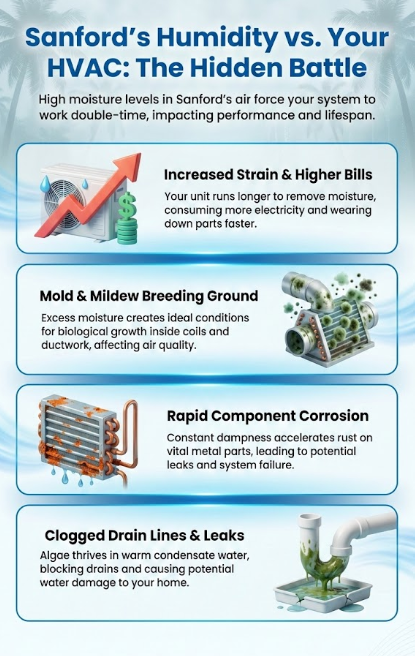
Sanford's humid subtropical climate keeps relative humidity above 70% for much of the year, forcing your HVAC system to work double duty — cooling air and constantly extracting moisture. That sustained workload accelerates wear across multiple components simultaneously.
Air filters take the first hit. Customers across Seminole County consistently report filters reaching full saturation two to three weeks earlier than manufacturer timelines suggest. A filter rated for 90 days in moderate climates may only last 60 in Sanford's summer conditions. Once saturated, airflow restriction spikes and forces the blower motor to compensate, driving up energy costs.
Evaporator coils collect excess condensation that mixes with airborne particulates, forming a film that reduces heat transfer efficiency over time. Condensate drain lines handle far more moisture output than in drier markets, creating ideal conditions for algae and mold blockages — one of the most common HVAC service calls in Central Florida. Ductwork with even minor leaks or insulation gaps becomes vulnerable to interior moisture intrusion, leading to mold growth and compromised indoor air quality.
After manufacturing millions of filters and analyzing real-world performance across Florida's highest-humidity markets, we see these failure patterns repeat with striking consistency in homes following generic national maintenance schedules.
A Humidity-Adjusted Maintenance Schedule for Sanford Homes
Standard 90-day maintenance cycles assume moderate climate conditions. Sanford doesn't qualify. Based on direct customer feedback and filter performance data from Central Florida, here's a localized schedule that accounts for the moisture your system actually faces.
Every 30–45 days during June through September. Replace air filters monthly during peak humidity. Standard 1" pleated filters saturate significantly faster in summer. Check condensate drain lines for blockages at the same interval.
Every 60 days during October through May. Shift to a 60-day filter cycle as humidity moderates. Continue monitoring condensate drainage and inspect duct connections for moisture intrusion.
Twice per year in spring and fall. Schedule professional inspections that include evaporator coil cleaning, refrigerant checks, and a full condensate system flush. This is where hidden humidity damage gets caught before it becomes expensive.
A system running on a clogged filter in high humidity works an estimated 15–25% harder than one with a clean filter, according to the U.S. Department of Energy. Over a full Sanford summer, that inefficiency translates directly to higher utility bills and shortened equipment life.
Warning Signs and Choosing the Right Filter for Humid Conditions
Between scheduled HVAC maintenance in Sanford, certain signals indicate humidity is outpacing your current routine. Visible condensation around the air handler suggests drainage problems. Musty odors from supply vents point to mold in the drain pan or ductwork. Rooms that feel clammy while the system runs indicate reduced dehumidification capacity — usually caused by dirty coils or a saturated filter. Unexplained summer spikes in your electric bill frequently trace back to a system fighting moisture-heavy air with restricted airflow.
If any of these appear, check your air filter first. In our experience, a prematurely clogged filter is the starting point for the majority of humidity-related issues customers report.
For most Sanford homes, a MERV 8 to MERV 11 pleated filter strikes the right balance between particle capture and airflow in humid conditions. Higher-rated MERV 13 filters offer superior filtration but can restrict airflow in systems not designed for that resistance — a problem that compounds when humidity is already taxing the blower motor. Customers tell us that upgrading from flat-panel fiberglass to pleated filters made a noticeable difference in both air quality and how long their system maintains consistent performance through Sanford's hottest months.
"After analyzing filter returns from thousands of Central Florida homes, the pattern is unmistakable — filters in high-humidity markets like Sanford degrade up to 30% faster than identical products in drier climates, and homeowners who don't adjust their replacement schedule accordingly end up paying for it in energy costs and early system failures."
Essential Resources for HVAC Maintenance in Sanford
Maintaining an HVAC system in Sanford's high-humidity climate requires more than routine filter swaps. These vetted government and industry resources give homeowners the guidance needed to protect equipment, verify contractors, and reduce long-term costs.
1. U.S. Department of Energy — Learn the Maintenance Steps That Prevent Costly Breakdowns
The DOE's official air conditioner maintenance guide covers filter replacement, coil cleaning, condensate drain care, and when to call a licensed technician. Start here to understand the baseline tasks that keep your system running efficiently in humidity-heavy climates.
Source: U.S. Department of Energy — Energy Saver
URL: https://www.energy.gov/energysaver/air-conditioner-maintenance
2. ENERGY STAR Maintenance Checklist — Know Exactly What Your HVAC Technician Should Inspect
This checklist details every step a qualified contractor should perform during a professional tune-up, from tightening electrical connections to checking refrigerant charge and cleaning coils. Use it to hold your Sanford HVAC provider accountable at every service visit.
Source: ENERGY STAR — U.S. Environmental Protection Agency
URL: https://www.energystar.gov/saveathome/heating-cooling/maintenance-checklist
3. EPA Mold and Moisture Guide — Protect Your Sanford Home from Humidity-Driven Mold Growth
The EPA recommends keeping indoor humidity between 30–50% to prevent mold. This guide explains how HVAC systems contribute to or prevent moisture problems and what to do when condensation or musty odors appear — both common warning signs in Central Florida homes.
Source: U.S. Environmental Protection Agency
URL: https://www.epa.gov/mold/brief-guide-mold-moisture-and-your-home
4. Florida Building Code — Understand the HVAC Standards Your Sanford Home Must Meet
Florida's residential building code sets requirements for HVAC installation, energy efficiency minimums, condensate drainage, and ventilation. Review these standards before approving any system replacement or major repair to confirm the work meets current code.
Source: Florida Building Code, Residential — 2023 Eighth Edition
URL: https://codes.iccsafe.org/content/FLRC2023P1/chapter-14-heating-and-cooling-equipment-and-appliances
5. Florida DBPR License Verification — Confirm Your HVAC Contractor Is Legally Licensed
Florida law requires all HVAC contractors to hold a valid state license through the Department of Business and Professional Regulation. Search by name or license number before signing any service agreement to avoid unlicensed work that can void warranties and violate code.
Source: Florida Department of Business and Professional Regulation
URL: https://www.myfloridalicense.com/wl11.asp?mode=2&search=Name&SID=&brd=&typ=
6. Seminole County Building Division — Verify Permits for HVAC Installations and Replacements
HVAC replacements and ductwork modifications in Sanford require a mechanical permit through Seminole County. This portal provides online permit applications, contractor registration verification, and inspection scheduling to ensure your project stays compliant with local requirements.
Source: Seminole County Government — Development Services
URL: https://www.seminolecountyfl.gov/departments-services/development-services/building
7. ENERGY STAR Federal Tax Credits — Save Up to $3,200 on Energy-Efficient HVAC Upgrades
Federal tax credits cover up to 30% of qualifying HVAC equipment and installation costs. Eligible upgrades include high-efficiency central air conditioners, heat pumps, and home energy audits — a significant offset for Sanford homeowners replacing aging systems worn down by humidity.
Source: ENERGY STAR — U.S. Environmental Protection Agency
URL: https://www.energystar.gov/about/federal-tax-credits
Supporting Statistics on HVAC Maintenance in Sanford
We manufacture millions of air filters annually and ship to every climate zone in the country. That gives us direct visibility into how filters perform under real conditions. These federal data points align closely with the patterns we see across Sanford and Central Florida's highest-humidity markets.
1. Clogged Filters Increase Energy Use by Up to 15%
The U.S. Department of Energy confirms that a dirty air filter can raise AC energy consumption by 5% to 15%. What the DOE doesn't specify is how fast humidity accelerates that timeline.
Here's what we see firsthand in Sanford:
Standard 1" pleated filters reach saturation 2–3 weeks earlier than identical filters in drier markets.
Homeowners following a generic 90-day cycle may run at peak inefficiency for a full month before replacing the filter.
That 15% energy penalty compounds daily — and most homeowners never connect it to a filter that looks "fine" but is already moisture-logged.
Source: U.S. Department of Energy — Air Conditioner Maintenance
URL: https://www.energy.gov/energysaver/air-conditioner-maintenance
2. Indoor Humidity Above 60% Creates Mold-Favorable Conditions
The EPA recommends keeping indoor humidity below 60%, ideally between 30–50%. Sanford's outdoor humidity averages 74% year-round and exceeds 77% in peak summer months. Local HVAC systems aren't just cooling air — they're working as full-time dehumidifiers.
Customers tell us the impact shows up in a predictable sequence:
A fouled evaporator coil or clogged condensate drain quietly reduces moisture removal capacity.
Indoor humidity crosses the EPA's 60% threshold without any visible warning sign.
Mold-favorable conditions develop inside ductwork and drain pans — often for weeks before musty odors or condensation appear near the air handler.
The pattern is preventable. But only if maintenance accounts for the constant moisture load Sanford's climate imposes.
Source: U.S. Environmental Protection Agency — A Brief Guide to Mold, Moisture, and Your Home
URL: https://www.epa.gov/mold/brief-guide-mold-moisture-and-your-home
3. Duct Leaks Waste 20–30% of Conditioned Air
ENERGY STAR estimates the typical home loses 20–30% of conditioned air through duct leaks, holes, and poor connections. In drier climates, that's an energy waste problem. In Sanford, it's also a moisture intrusion problem.
We've heard from Central Florida customers who:
Replaced filters on an aggressive schedule and still experienced musty odors and uneven cooling.
Discovered duct leaks were pulling humid attic or crawlspace air directly into the system.
Saw mold developing at duct connections months before a scheduled inspection would have caught it.
Every gap becomes a moisture entry point that degrades insulation, promotes mold growth, and forces longer system runtimes. After years of tracking these patterns, our recommendation is straightforward: annual duct inspections are not optional in high-humidity markets. They're as essential as the filter itself.
Source: ENERGY STAR — Duct Sealing
URL: https://www.energystar.gov/saveathome/heating-cooling/duct-sealing
Final Thought: Sanford's Humidity Isn't a Seasonal Problem — It's a Year-Round Maintenance Reality
Most HVAC maintenance advice treats humidity as a summer inconvenience. In Sanford, it's a permanent operating condition. With average humidity holding above 70% year-round, every component in your system faces moisture exposure that generic national guidelines don't account for.
The core takeaway from this page is simple: maintain your system for the climate you actually live in.
For Sanford homeowners, that means:
Filters: Replace every 30–45 days during June through September. Extend to 60 days October through May.
Condensate drains: Check monthly during peak humidity — not annually.
Evaporator coils: Schedule professional cleaning twice per year, spring and fall.
Ductwork: Inspect annually for leaks and moisture intrusion that Sanford's climate makes inevitable.
Our Perspective After Manufacturing Millions of Filters for High-Humidity Markets
After years of manufacturing filters, analyzing return data, and listening to Central Florida customers, here's what we believe:
The biggest threat to an HVAC system in Sanford isn't a single catastrophic failure. It's the slow, invisible accumulation of moisture-driven damage that happens between maintenance visits.
Consider what goes unnoticed every day in a high-humidity home:
A filter at 80% saturation still moves air — but forces the blower motor to work harder with every cycle.
A condensate line with early-stage algae growth still drains — but is weeks away from a full blockage.
An evaporator coil with a thin film of buildup still cools — but transfers heat less efficiently with each passing day.
None of these trigger an obvious alarm. All of them quietly increase energy costs and shorten equipment life by months or years.
The homeowners who get the most from their systems in this climate share one habit: they stopped treating maintenance as a reaction to problems and started treating it as prevention against humidity's constant, compounding pressure.
One Action Worth Taking Today
We built our filter subscription service around a single data point — the most common point of failure in humid markets is a filter that stayed in the system too long. Not a compressor. Not a refrigerant leak. A filter.
If you're in Sanford and it's been longer than 45 days during summer or 60 days any other time of year, your filter is almost certainly ready to be replaced. That one step protects every component downstream and costs a fraction of what neglecting it will.
FAQ on HVAC Maintenance in Sanford
Q: How often should I replace my air filter in Sanford?
A: More often than the packaging recommends. After manufacturing millions of air filters and tracking return data across Central Florida, we see a consistent pattern. Standard 1" pleated filters reach full saturation 2–3 weeks earlier in Sanford than identical filters in drier markets. That holds across brands and MERV ratings.
Our data-backed replacement schedule:
June through September: Every 30–45 days.
October through May: Every 60 days.
One detail most guides leave out — the feel test. If the filter is damp, heavy, or visibly gray when you pull it, humidity has already compromised performance regardless of install date. Customers who switched to a humidity-adjusted cycle consistently report lower energy bills and fewer mid-summer service calls.
Q: What HVAC maintenance tasks are most important for Sanford's humid climate?
A: After hearing directly from homeowners across Seminole County for years, we've narrowed it to four tasks that prevent the vast majority of humidity-related breakdowns:
Filter replacement on a humidity-adjusted cycle. Every 30–60 days depending on the season. Not every 90 days. This single change eliminates the most common failure point we see in Central Florida.
Monthly condensate drain line checks from May through October. Algae and biofilm thrive in Sanford's heat. A blocked drain is the second most reported issue before a service call.
Professional evaporator coil cleaning in spring and fall. Coil fouling reduces dehumidification before it reduces cooling. Homeowners often don't catch it until mold or musty odors appear.
Annual duct inspection for leaks and moisture intrusion. Every duct leak in a humid climate is also a moisture entry point — not just an energy loss.
The insight most generic lists miss is the sequence. In our experience, the chain almost always starts with a filter that stayed in too long:
Saturated filter → restricted airflow → coil fouling → reduced dehumidification → service call.
Interrupt the chain at the filter and most downstream problems never develop.
Q: How do I know if humidity is damaging my HVAC system?
A: Five warning signs we hear most often from customers in Sanford and Central Florida:
Condensation or water stains near the air handler. The condensate system is overwhelmed or partially blocked.
Musty odors from supply vents. Almost always traces to biological growth in the drain pan, coil, or ductwork.
Rooms feel clammy while the system runs. Signals reduced dehumidification. A fouled coil or saturated filter can still cool air but loses moisture removal efficiency.
Unexplained summer electric bill spikes. The DOE estimates a clogged filter increases energy use by up to 15%. In Sanford, where systems run 10–14 hours daily in peak summer, that adds up fast.
Filter looks fully loaded well before its change date. The earliest and most reliable indicator. If saturated at 30 days on a 90-day cycle, humidity is outpacing your routine.
What we've learned from analyzing thousands of filter returns: symptoms 2–4 rarely appear alone. They almost always trace back to a filter that crossed the saturation threshold weeks earlier. Check the filter first. It's the cheapest diagnostic in the system.
Q: Do I need a permit for HVAC work in Sanford?
A: Yes. System replacements, new installations, and ductwork modifications require a mechanical permit through the Seminole County Building Division. Florida law also requires every HVAC contractor to hold a valid state license through the Department of Business and Professional Regulation.
Before authorizing major work, confirm two things:
Permit status. Your contractor has pulled the required Seminole County permit.
License verification. Their license is active and verifiable at MyFloridaLicense.com.
What customers tell us about unpermitted work — the problems don't surface immediately. They appear months later as:
Warranty claim denials.
Failed home inspections during resale.
Insurance coverage gaps after storm damage.
Two checks. Five minutes. Thousands of dollars in liability prevented.
Q: What MERV rating is best for Sanford homes?
A: MERV 8 to MERV 11 for most residential systems. That recommendation comes directly from manufacturing filters for high-humidity markets — not from a generic compatibility chart.
The nuance most filter guides overlook: higher isn't always better in a humid climate. MERV 13 offers superior particle capture. But in systems not engineered for that static pressure, it restricts airflow in ways that compound fast when humidity is already taxing the blower. The result:
Accelerated filter saturation.
Reduced dehumidification capacity.
Frozen evaporator coils during peak summer operation.
What customers tell us made the biggest difference wasn't jumping to the highest MERV available. It was two changes together:
Upgrading from flat-panel fiberglass to a quality pleated filter in the MERV 8–11 range.
Replacing it on a humidity-adjusted schedule.
That combination outperforms a premium filter left in too long every time. If considering MERV 13 or above, have your HVAC technician measure static pressure first to confirm your system can sustain it through a full Sanford summer.
Protect Your Sanford Home From Humidity-Driven HVAC Damage — Starting With the Right Filter
Sanford's year-round humidity won't wait for your next scheduled maintenance visit. Check your current filter today and switch to a humidity-adjusted replacement schedule that keeps your system running efficiently through every Central Florida season.
Here is the nearest branch location serving the Cutler Bay FL area…
Filterbuy HVAC Solutions - Miami FL
1300 S Miami Ave Unit 4806, Miami, FL 33130
(305) 306-5027